
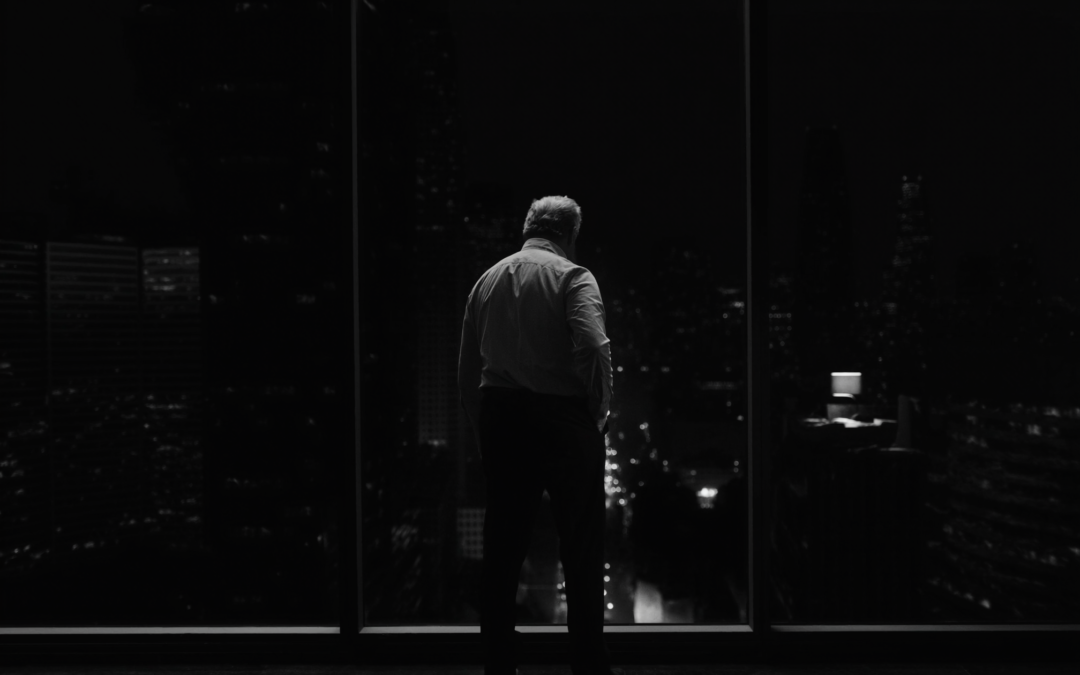
Every senior leader knows the moment. The data is incomplete and will stay incomplete. The two proposals left on the table differ more in adjectives than in outcomes. Legal has flagged both. The room has stopped debating and started watching — because the only thing it still needs from you is motion.
Most writing on executive decision making has nothing useful to say about this moment. It is too polite. It will teach you to listen, to align, to weigh stakeholders — all real, all necessary, and all useless at the exact second the conversation is over and the obligation to act arrives. Why on earth do we keep pretending that hard decisions are made with better spreadsheets? When there is no good option, the decision is not a thinking problem but a courage problem — and courage has a psychology, including its ugly parts.
What Execution Power Actually Is
One of my clients calls it “execution power”: the ability to do things, and make things, and accelerate things. Plenty of executives can talk about change and plan for it. Making it happen under uncertainty requires an entirely different mentality.
In my book I describe leadership not as a personality type but as a repertoire of five psychological stances — the Collective, the Strategist, the Father, the Decision-Maker, the Creative — an idea that sits close to the leadership archetypes boards keep getting wrong. The Decision-Maker is the crisis stance: the capacity to convert ambiguity into motion. Not to resolve ambiguity — to convert it. Waiting for resolution is how companies die slowly while congratulating themselves on their rigor.
Read Isaacson’s biographies of Musk and Jobs and you see this stance in its rawest form. What makes it possible, put short and simple, is learning how to not give a f*ck. About others, about reality, about money, about time. People who struggled to attach early in life often learned to build a reality of their own — one in which they make the rules — which is why the detached are rarely impressed by “it can’t be done,” and why the same machinery, unwatched, hardens into the reality distortion field. The engine and the pathology are the same part. That is precisely why the leadership industry won’t discuss it: it is easier to sell empathy than to explain when detachment is the most responsible thing in the room.
The Dangerous Engine: Thanatos
Decision-makers run on instinct, gut feel, and power. Freud gave that last ingredient its proper name. Against Eros he set Thanatos, the horse of the death drive: it contains an incredible power but will ultimately drive the wagon into the abyss. That is execution power in one sentence. It cuts through everything — committees, conventions, feelings, sunk costs — and while operating it leaves victims and destruction.
So the rule is structural, not moral: this stance is used sporadically, with the greatest care and commitment, and it is borrowed, never lived in. A leader who visits the Decision-Maker saves companies. A leader who moves in produces attrition and learned helplessness — people stop thinking, because thinking is no longer rewarded, only obedience.
Notice also what this stance runs on: raw power, not earned consent — which is why a leader who confuses the two should first sit with the difference between authority and legitimacy. Power compels the swing. Legitimacy is what determines whether anyone is still standing with you after it lands.
Critical Friendship
The most dangerous decisions are the ones nobody around you is licensed to question.
Executive CoachingThree Questions Before You Swing
Because Thanatos — the raw drive to cut through — is a magnificent engine and a poor pilot, I give clients three questions to ask before the swing. They take ninety seconds. They are the difference between decision making under uncertainty and gambling with other people’s lives.
1. Is the decision truly time-sensitive?
Most “urgent” decisions are not. Urgency is frequently an emotion wearing the costume of a deadline — someone’s anxiety demanding to be discharged. But some decisions genuinely rot: the price of waiting inflates the future bill. The real ones feel specific. Rooms begin to recycle arguments. The last two proposals converge. And you notice the particular exhaustion that comes from standing at a fork in the road, staring. Entire boards mistake that exhaustion for diligence — a pattern I unpack in the dynamics of the boardroom under pressure.
2. Is the door one-way or two-way?
Reversibility is the hinge of the whole discipline. Choose the Decision-Maker when delay costs more than error, when reversibility is low but clarity is high, or when reversibility is high and clarity is merely decent. A two-way door forgives speed; walk through it, watch, walk back if you must. A one-way door forgives nothing — it deserves your slowest hour, not your fastest. Executives wreck themselves by inverting this: agonizing for months over reversible calls, then making the irreversible one at 11 p.m. from frustration.
3. Who will absorb the externalities?
Every hard swing produces debris — careers, trust, energy. Someone pays. The honest question is whether the people deciding are also the people absorbing. If the answers to the three questions are “Yes, two-way, we will,” the Decision-Maker is not optional. It is mandatory, and must be held with care. If the answer to the third question is “people who are not in this room,” slow down. That is not decisiveness; that is cost-shifting with a confident voice.
Never Decide From Anger; Decide After Anger
The psychological skill underneath all of this is affect regulation: to use power without being used by adrenaline. The rule I give clients in executive coaching is simple — never decide from anger; decide after anger.
The rule does not say anger is wrong. Anger is often the first accurate signal a leader has felt in weeks: something here must change. The error is letting the signal drive. Anger is a brilliant smoke alarm and a catastrophic fire chief. The hard calls — the restructure, the exit of a loyal executive, the kill decision on a flagship project — must be made in a rational state, with the emotion fully felt and fully finished.
“Never decide from anger; decide after anger. Thanatos is a magnificent engine and a poor pilot.”
This pause is not softness; it is architecture. The same machinery separates discipline from motivation: motivation is emotional, discipline is structural, and the discipline of pause is what stands between a leader and the irreversible. Twenty-four hours between the surge and the signature. A walk before the termination call. The decision rarely changes. The collateral damage almost always does.
Ada’s Rhythm: Debate Deeply. Decide Quickly. Execute Relentlessly. Reflect Honestly.
How do CEOs actually make hard decisions well, repeatedly, without burning the house down? The cleanest answer I know comes from Ada — the Norwegian COO described at length in Let’s Talk Leadership. Articulate, empathic, adored by her team, and completely unable to act. Plans stalled, projects lingered, meetings ended with smiles and no deliverables, until one investor put it brutally: “We don’t need another philosopher. We need a general.” Her paralysis was not cognitive. She was so attuned to everyone’s feelings that every “no” felt like betrayal. Forced onto decision windows, she discovered what most over-deliberating executives eventually admit: “I used to think time created quality. But actually, it only created anxiety.”
What she built instead was a rhythm — and each beat forbids something specific.
Debate deeply. Real debate, with real dissent, before the decision. What this phase forbids is the counterfeit version: harmony theater, recycled arguments, consensus by fatigue. If nobody has disagreed with you yet, you have not debated; you have rehearsed.
Decide quickly. Once the debate has genuinely happened, choose — inside a window, not a season. What this forbids is the wait for certainty that is never coming. The data will still be incomplete next quarter.
Execute relentlessly. What this forbids is relitigating the decision mid-flight. A decision reopened weekly is not a decision; it is a hostage. Execution is where the Decision-Maker’s detachment becomes a service rather than a threat.
Reflect honestly. What this forbids is self-congratulation. Count the casualties. Ada’s crisis sprint shipped the product and cost her a senior developer who left calling her “too aggressive” — both facts were true, and the reflection had to hold both. Out of that debrief came her refined rule, written on a Post-it on her monitor: never decide from frustration; only from clarity.
Her range expanded — not because leadership can be installed in anyone, but because an old adaptation was finally allowed to become an option rather than a prison. The instinct was always there. The work was subtracting what blocked it.
From the Book
Ada’s full case — and the other four perspectives every senior leader must learn to visit — appears in Let’s Talk Leadership, endorsed by Marshall Goldsmith.
Explore the BookWho Steers You Back From the Abyss
Freud’s warning comes with an instruction attached: if you summon this power, surround yourself with people who will steer you away from the abyss when needed. In practice that means three control surfaces.
Guardrails are pre-commitments made in a cold state to protect you in a hot one. My favorite for this stance: every high-impact, one-way decision requires one dissenting view to be articulated by the leader before the decision is final. Not heard. Articulated, by you, out loud. If you cannot state the strongest case against your own swing, you have not earned it.
Witnesses are the two or three people in your orbit with explicit permission to name your stance in real time: “We are in decision-maker energy. May I propose we return to strategist for ten minutes to check consequences?” If that sentence sounds awkward, weigh it against the cost of unspoken confusion. The brain is a social organ; distributed monitoring is what keeps a stance chosen rather than compulsive. This is, frankly, most of what I do in a coaching room — critical friendship, the balance between love and confrontation, which is the spine of how I work with executives.
Language is the most underrated of the three. The Decision-Maker speaks in “now” and “then,” in declaratives with rationale, in time stamps. When you hear that grammar leaking into your Friday one-to-ones, you have drifted. The stance has stopped being a tool and started being a residence. And the residence always ends the same way: the wagon, the horse, the abyss.
Then It Feels Like Oxygen
After Ada cancelled her first dragging project — one short, direct email ending eight months of polite paralysis — half the responses were shock, half relief, and several thanked her. That is the paradox nobody warns decision-hesitant leaders about: clarity feels cruel until it happens. Then it feels like oxygen.
So no, there was never a good option. There rarely is, at this altitude. There is a time-check, a door-check, an externality-check; there is anger fully felt and then fully set down; there is a rhythm, a guardrail, and two or three people licensed to grab the reins. And then there is you — calm enough to borrow the most dangerous stance in leadership, and whole enough to give it back when the swing is done. Whether that describes the kind of work you are ready to do is worth an honest look at who this is actually for. The decision was never the hard part. Remaining someone you recognize afterward — that is the work.
Related Reading
The Leadership Shadow: What You Deny in Yourself Runs Your Company
The Source: Why Your Leadership Style Is an Echo of Your Attachment History
Narcissistic Leadership: The Engine Nobody Wants to Name
TRUE Leadership
Facing a one-way door?
Critical friendship for executives carrying irreversible decisions — radical honesty, no standard contracts, first conversation at the kitchen table in Drachten.
Book a confidential call Is This For Me?