
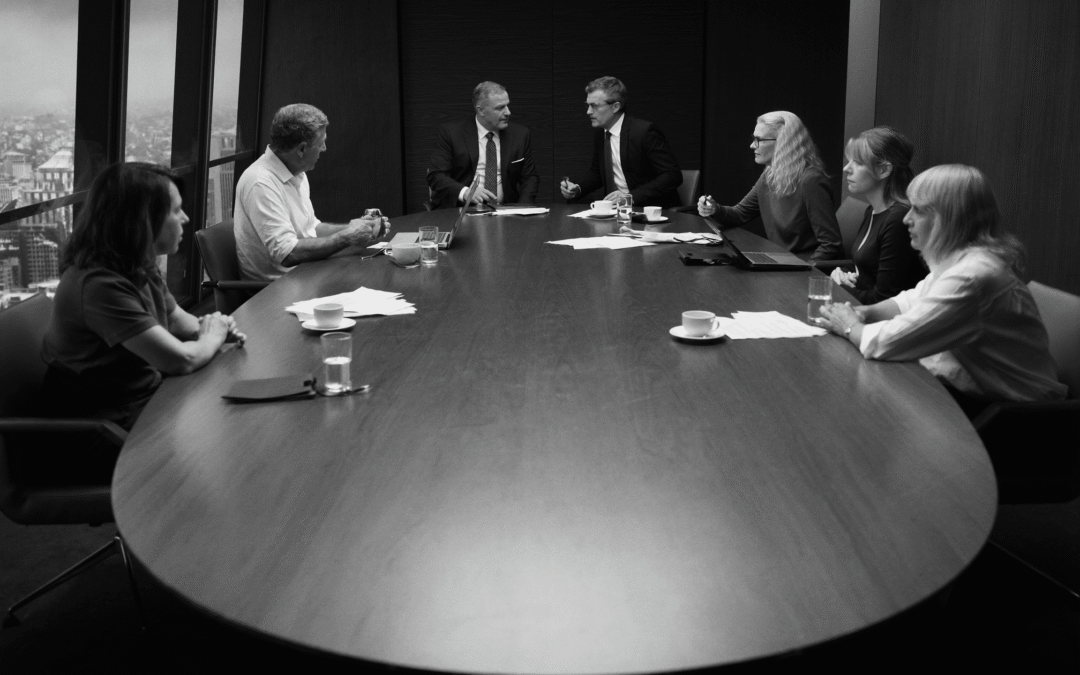
On the psychology of power at the top, the mirrors that distort, and why the most important conversations happen in the room where the fewest people feel safe to speak.
Every boardroom has two meetings. The first is the one on the agenda — strategic reviews, financial updates, governance matters. Formal, structured, documented in minutes that will be approved at the next session. This is the meeting everyone acknowledges.
The second meeting is the one happening underneath. Who defers to whom. Whose questions get answered and whose get deflected. Which topics generate engagement and which produce a particular quality of silence — not the silence of satisfaction, but the silence of things unsaid. Who makes eye contact with whom when the CEO finishes speaking. Where the energy shifts when a contentious topic is raised. This second meeting — the unspoken one — is where the real power dynamics live. And it is the meeting that determines whether the organisation is actually well-governed or merely appears to be.
In my coaching practice, I work regularly at this level — with CEOs, board chairs, and senior leadership teams. What I observe, consistently, is that the most consequential decisions are shaped not by data or strategy but by relational dynamics that no governance framework acknowledges and most board members cannot name.
The System Mirrors the Leader
In Let’s Talk Leadership, I argue that every distortion within the leader becomes organisational architecture. This is systems theory in action: the organisation is a living projection of the leader’s psychology. When a CEO avoids conflict, the board learns to avoid conflict. When a leader hoards information, the system develops information silos. When the chair rewards loyalty over competence, the room fills with people who agree for a living.
Corporate governance is built on the assumption that boards make rational decisions based on data, expertise, and fiduciary duty. This is a useful fiction. In practice, boardroom decisions are shaped by status hierarchies, personality structures, and emotional undercurrents. The research is clear: group decision-making quality degrades predictably when groupthink, authority bias, pluralistic ignorance, and what Irving Janis called the ‘illusion of invulnerability’ take hold.
I see these patterns regularly. A board that rubber-stamps CEO proposals because challenging them feels socially unsafe. A leadership team where the CFO’s perpetual scepticism has become so ritualised that it is no longer processed as genuine input — it is just what the CFO does, and everyone has learned to wait it out. A supervisory board where one dominant personality’s preferences are treated as consensus because nobody wants to be the person who disagrees with the most senior voice in the room.
Neuroscience explains why these dynamics are so persistent. The human brain constantly attunes to the most emotionally dominant person in the room. In groups, that is almost always the formal leader. Your nervous system — your emotional state, your tension, your calm — becomes the weather system the rest of the room inhabits. I once coached a CEO during a corporate crisis who wanted to launch a ‘stabilisation campaign’ full of statements and slogans. I said: ‘Let’s start with your breathing.’ Over weeks, he learned that the way he entered a room changed everything. When he walked in tense, the collective heartbeat spiked. When he took a deep breath, smiled, and said: ‘Let’s look at this together,’ the entire energy shifted.
The Five Dysfunctions at Board Level
At the C-suite and board level, dysfunction takes specific forms that are worth naming precisely, because naming them is the first step to interrupting them.
Choreographed candour. The team has learned to perform openness without practising it. Feedback is given in pre-approved language. Challenge is offered on safe topics — logistics, timelines, budget line items — while the real issues remain untouchable: the CEO’s leadership style, the failing business unit everyone can see, the board member who has not contributed a useful thought in two years. The performance of openness substitutes for the reality of it.
Coalition governance. Decisions are pre-negotiated in bilateral conversations before the meeting. The boardroom session becomes a ratification ceremony. This looks efficient — meetings are short, decisions are crisp — but it eliminates the generative conflict that produces better thinking. The diversity of perspective that makes a board valuable is neutralised before the meeting begins.
The expertise trap. Board members defer entirely to whoever holds the relevant technical expertise — finance to the CFO, technology to the CTO, legal to the general counsel — without questioning assumptions, challenging models, or asking the naive questions that often reveal the most important blind spots. The result is a collection of silos presenting to each other, not a governing body thinking together.
Status anxiety. In mixed boards combining executive and non-executive directors, status differences create invisible barriers to genuine dialogue. Non-executives may feel they lack ‘operational credibility’ to challenge, while executives may feel that non-executives do not understand the reality on the ground. This dynamic mirrors the authority-legitimacy gap at the individual level — positional authority without relational legitimacy.
The missing voice. The person in the room with the most relevant insight often has the least positional power — the relatively junior board member, the recently appointed director, the only woman at the table, the newcomer who has not yet learned the room’s unwritten rules about what can and cannot be said. Structural dynamics silence them before they speak.
BOARDROOM COACHING
The boardroom is where leadership is tested — and where it most often fails silently.
Executive coaching for the dynamics that matter most.
The Chair’s Crucial Role
The single most important variable in boardroom dynamics is the chair. A skilled chair manages not just the agenda but the emotional temperature of the room, the participation balance, and the quality of disagreement. A weak chair allows the loudest voice or the highest-status participant to dominate unchallenged. A controlling chair suppresses the very diversity of perspective that makes a board valuable.
I frequently coach board chairs specifically on this capability — the ability to create space for productive conflict without losing control, to draw out the quiet voice without putting it on the spot, to summarise in ways that include rather than curate, to hold silence long enough for the important thought to surface. It is one of the most demanding forms of leadership, and one of the least discussed. The chair must manage both the process and the psychology of the room simultaneously, which requires a level of self-awareness and emotional regulation that few leadership development programmes address. (See also: Leadership Loneliness for the particular isolation of this role.)
What Changes the Room
Boardroom dynamics are not fixed. They are patterns — deeply entrenched, often decades old, but patterns nonetheless. And patterns can be interrupted. But the intervention must come from outside the system. You cannot change the dynamics of a room while you are subject to them. This is one of the fundamental principles of systemic coaching.
In the stakeholder-centred approach I use, we combine individual coaching for key players with team-level observation. The CEO works on their impact on the room. The board chair works on facilitation that draws out dissent. Individual members work on their specific behavioural patterns — the one who dominates, the one who withdraws, the one who only speaks to oppose. Each person receives stakeholder data about how they are experienced in the room, and each commits to specific behavioural changes.
Simple structural changes also produce disproportionate effects. Rotating who speaks first in a round-table discussion. Requiring written pre-reads with positions stated before the meeting. Using anonymous polling on contentious decisions before opening discussion. Designating a ‘devil’s advocate’ role that rotates each meeting. These are not gimmicks — they are process designs that systematically counteract the predictable biases of group dynamics.
The Narcissistic Dynamic in the Boardroom
In Red de Alfawolf, Martin Appelo and I describe how narcissistic leadership patterns play out in governance settings with particular intensity. The unpolished alpha wolf in a boardroom creates a specific kind of dysfunction: they dominate not through formal authority alone but through sheer emotional force. Their certainty fills the room, crowding out doubt, nuance, and the tentative voices that often carry the most important insights.
But here is the paradox: in crisis, this same dynamic can be exactly what the board needs. The alpha wolf who takes charge, makes decisions quickly, and radiates certainty provides the stability that a frightened system craves. The question is not whether the alpha wolf belongs in the boardroom. It is whether the room has the structural integrity to channel that energy productively rather than being overwhelmed by it. (For the framework on polished versus unpolished alpha leadership: Narcissistic Leadership.)
Breaking the Silence
The defining characteristic of boardroom dysfunction is that everyone in the room can feel it and nobody names it. The CEO knows the CFO is undermining them in bilateral conversations. The non-executive directors know the strategy is flawed. The board secretary knows the minutes do not reflect what actually happened. But the system protects itself through silence — not the silence of peace, but the silence of complicity.
Breaking this silence requires someone outside the loyalty economy — someone whose job is to name the pattern, not to protect it. That is what Critical Friendship means in practice: the willingness to say what the room already knows but nobody will articulate. Not because it is comfortable — it never is — but because the cost of continued silence is always higher than the discomfort of truth.
Leadership, as I write in my book, is a relationship with reality. The boardroom is where that relationship is tested most severely — and where it most often fails in silence. The quality of governance is ultimately the quality of the conversations the board is willing to have. Everything else is paperwork. (For the comprehensive coaching framework: Leadership Coaching for Senior Executives.)
CONTINUE READING
Arvid Buit is an executive coach and founder of TRUE Leadership. Author of Let’s Talk Leadership and Red de Alfawolf (with Martin Appelo). Certified by ICF, NOBCO, EMCC, and APECS. Marshall Goldsmith trained.
TRUE LEADERSHIP
Ready for a Different Kind of Conversation?
Executive coaching that confronts the dynamics nobody else will name.