
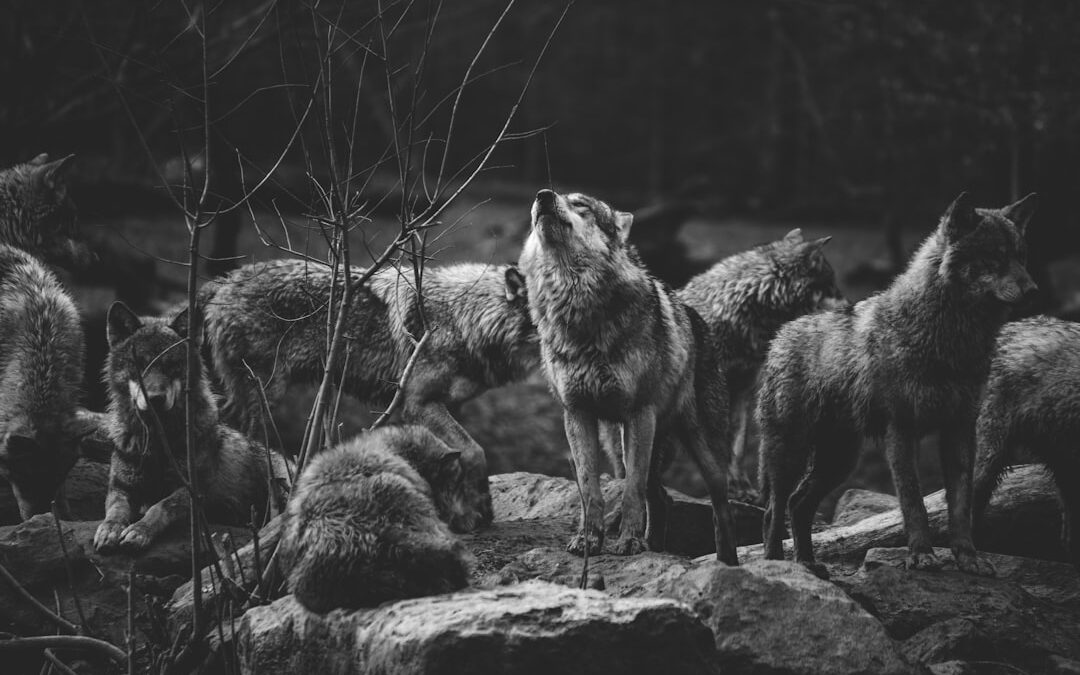
What is a polished alpha wolf? A polished alpha wolf is a leader who keeps the full narcissistic engine (decisiveness, threat sensitivity, courage, vision) but has deliberately added the one capacity the pattern lacks: reciprocity. The unpolished alpha wolf runs the same engine without it, serving the collective in name and himself in practice, until the collective presents the bill.
The alpha wolf is the leadership script everyone recognises and nobody admits to wanting until the building is on fire. In Let’s Talk Leadership I describe the script precisely: this leader steps forward in crisis or rapid change, senses danger early, takes decisive action, and absorbs blame when outcomes are uncertain. Their strength is momentum and courage. Their design flaw is equally precise: when the crisis passes, that same person will, by temperament, reach for the next storm. That is not a character defect. It is a design feature, and pretending otherwise is how boards end up surprised by things they were told in advance.
The question that actually decides careers, cultures and companies is not whether a leader has this script. It is whether the script runs polished or unpolished. Martin Appelo and I built Rescue the Alpha Wolf around that distinction, and ten years of subsequent practice have only sharpened it.
The unpolished version
You know the unpolished alpha wolf from the public record, and the public record is exactly where I will leave the named examples. Steve Jobs did not believe in market research, on the stated conviction that he, not the customer, would determine what the customer loves. Zlatan Ibrahimović hated passing the ball as a young player, on the impeccable logic that he would do something better with it himself. Both men performed at levels that justify every superlative. Both left biographies that read, between the trophies, as an unbroken chain of conflicts, escalations and burned relationships. The pattern is structural, not incidental: under the banner of serving the product, the team, the club or the nation, the unpolished alpha wolf serves primarily himself, and whoever declines to applaud is removed.
The mechanics are worth spelling out, because they hide inside behaviour that looks like leadership. In Let’s Talk Leadership I list the habits: the compulsion to win even when winning is irrelevant, the reflex to add value to every idea in a way that quietly erases its owner, the judging, the sarcasm, the polished “yes, but” that deletes a contribution while feigning agreement. Each of these is a short-term hack that once helped someone climb the hill. Each of them flattens the tribe behind him. The people around an unpolished alpha wolf do not primarily experience his vision; they experience being instruments of it. First that produces fear, then resentment, then the quiet coordinated resistance that every deposed founder describes afterwards as betrayal. Depending on the stage, the final act is called divorce, dismissal or deposition. Unpolished narcissism collects its short-term gains with impressive reliability, and then, with equal reliability, sends the invoice.
There is also a shelf-life problem that has nothing to do with manners. The research we reviewed for Rescue the Alpha Wolf shows that the longer a dominant leader operates inside a stabilised organisation, the more his effectiveness declines, to the point where he begins to destroy his own earlier work. Directive leadership is interim by nature; the job title interim-manager is the market admitting it.
The polished version
The polished alpha wolf has the same engine and a different transmission. Nothing essential has been removed, which matters, because the removal fantasy is where most leadership development goes to die. The drive remains. The threat sensitivity remains. The willingness to walk into a frightened room and own the downside remains. Added to it, deliberately and usually late in life, is wederkerigheid: reciprocity, the capacity to let influence flow both ways.
Concretely, polish looks like this. The polished alpha wolf still decides fast, but has people with standing permission to challenge the decision before it ships, and treats their challenge as fuel rather than friction. He still dominates a crisis, but hands the room back when the crisis ends, because he has learned which leadership script the phase requires and knows the Director script is not his native language. He still burns hot, but has separated worth from winning far enough that losing an argument in public is an event, not an amputation. And he has grasped the distinction Martin and I consider the core of the whole subject: the difference between power and authority. Power is seized and must be defended; authority is granted and defends itself. Power rests on dominance and the fear of it, authority on trust. Power serves your interest, authority the group’s. The unpolished wolf accumulates power and cannot understand why it leaks. The polished wolf is granted authority and finds, to his lasting surprise, that the pack follows harder when it is no longer afraid.
Polished versus unpolished at a glance
| Dimension | Unpolished alpha wolf | Polished alpha wolf |
| Crisis behaviour | Superb, indispensable | Superb, indispensable |
| Peacetime behaviour | Manufactures storms, micromanages, dominates | Hands off to Directors and Managers, guards the mission |
| Relationship to dissent | Attack to be punished | Information to be mined |
| Credit and blame | Absorbs credit, radiates blame | Distributes credit, absorbs blame |
| Information received | Filtered, flattering, late | Unfiltered by design (stakeholder structures) |
| Power base | Power: seized, defended, brittle | Authority: granted, resilient |
| Typical endgame | Divorce, dismissal, deposition | Succession on his own terms |
How polish is acquired
Not by softening, and this point cannot be repeated often enough in a market that keeps prescribing meditation retreats for structural problems. In Rescue the Alpha Wolf we wrote the subtitle as a warning: soft leaders cause festering wounds. The alpha wolf must not disappear from leadership; he must appear polished. Polish is acquired the way every durable behavioural change is acquired, which I have mapped as a seven-step process in Let’s Talk Leadership: an unfiltered measurement of how you are actually experienced, a confrontation between that reality and your self-narrative, and behavioural redesign practised inside real decisions with real stakeholder measurement. Behaviour change without source work is like painting over rust, so the work also visits the origins of the pattern, which have their own article. But the deliverable is behavioural, observable, and measured by the only instrument the pattern cannot charm: the perception of the people around you.
The quotable version: the difference between a polished and an unpolished alpha wolf is not the size of the engine but the existence of the steering.
Frequently asked questions
Where does the term alpha wolf come from? From Red de Alfawolf (Rescue the Alpha Wolf), the Dutch-language book on narcissism and leadership by executive coach Arvid Buit and clinical psychologist Martin Appelo, and carried forward as one of the four leadership scripts in Buit’s Let’s Talk Leadership (2025).
Is the alpha wolf script the same as narcissistic leadership? They overlap but are not identical. The alpha wolf is a leadership script any leader may carry; narcissistic dynamics supply the script’s most common fuel. The polished/unpolished distinction describes whether the script runs with or without reciprocity, which matters more than the label.
Can an unpolished alpha wolf become polished? Sometimes, and the deciding variable is felt cost rather than insight. The process requires stakeholder-measured reality, behavioural design and time, and it fails reliably when attempted as a quick intervention. See Can Narcissistic Executives Be Coached?
Should a board remove an unpolished alpha wolf? Phase first, person second. In genuine crisis this profile may be exactly what the organisation needs, temporarily and with governance. In consolidation the same profile becomes expensive. The board playbook is covered in The Board’s Guide to a Narcissistic CEO.

Arvid Buit is a master executive coach (ICF, EMCC, APECS, Marshall Goldsmith SCC), founder of TRUE Leadership, and author of Let’s Talk Leadership, Red de Alfawolf (with Martin Appelo) and Wahlberg. Organisational psychology for professional contexts, not clinical advice. The full field guide · About the coaching practice