
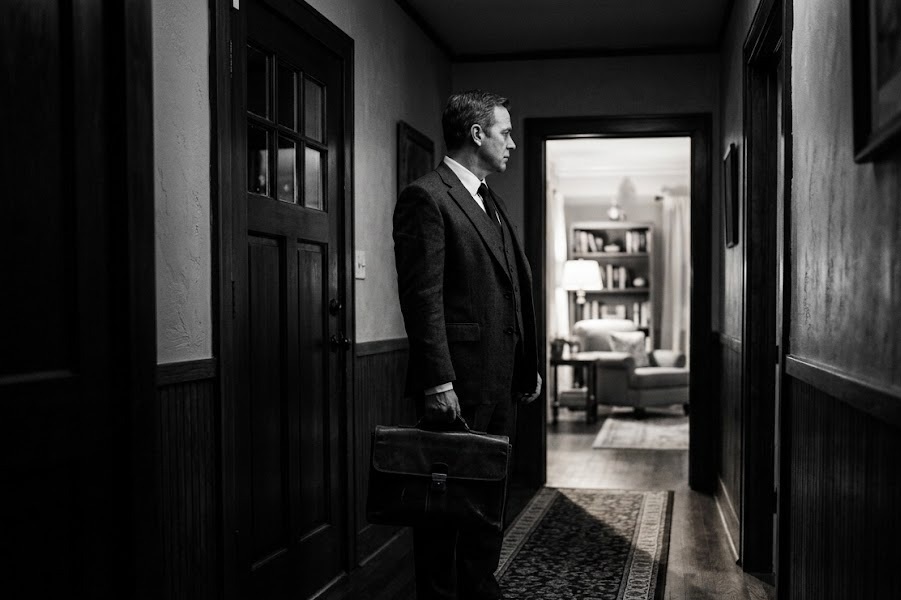
Authority does not come off at the front door. That is the part almost nobody plans for. Executives prepare for the scrutiny, the board, the succession politics, the loneliness of the seat. They do not prepare for the fact that the role travels home in the body — that the same competencies rewarded all day are still running at the kitchen table, and that inside intimacy those competencies are not merely useless. They are corrosive.
I work with CEOs, CFOs and owners of substantial, often family-held companies. When something is genuinely wrong, it very rarely shows up first in the numbers. It shows up in a marriage that has gone strangely polite. In friendships that have thinned into an audience. In a house where everyone has learned, without anyone announcing it, to read the mood at the door before they speak.
The four exports
Ask what actually makes someone effective at the top and you get a short list. Deciding fast on partial information. Sorting people by usefulness — who moves this forward, who does not. Converting feeling into action rather than sitting inside it. Holding a position under sustained challenge without wobbling. Those four are not character flaws. They are the job. Strip them out and the organisation stalls.
Now put each one into a marriage.
Deciding fast on partial information
At work, waiting for certainty is a form of cowardice; you decide at seventy per cent and correct on the move. At home, deciding at seventy per cent means your partner is halfway through a sentence and you have already produced the answer. You are not listening — you are triaging. You experience this as efficiency. They experience it as being closed before they were open.
Sorting people by usefulness
The executive mind is a sorting machine. Relevant, not relevant. Additive, subtractive. It has to be. But intimacy is precisely the domain where a person’s value is not instrumental, and people know instantly when they are being assessed rather than met. Children in particular know. They cannot name it, so they adapt to it instead.
Converting feeling into action
Something hurts, so you fix something. A difficult evening becomes a booked holiday. A distressed partner becomes a solved problem, and the solving is offered as love. It is offered as love. But the message underneath is: your feeling is a fault condition and I am closing the ticket. Do that for long enough and the feelings stop being brought to you at all.
Holding a position under challenge
In a boardroom, changing your mind because someone pushed hard is a liability. In a marriage, refusing to be moved by the person who knows you best is not integrity — it is armour. And the leader who has spent fifteen years learning not to flinch will not notice the moment the armour stopped being situational and became the skin.
None of this is malice. That is exactly what makes it hard to see. Every one of these habits was rewarded, publicly, for years. This is the terrain I describe as the shadow side of leadership: not the dark secret, but the ordinary strength running in the wrong room.
The unpaid regulator
Here is the export that costs the most, and the one leaders are least willing to look at directly.
Somewhere in the arrangement, a partner has been promoted — without consultation, without a conversation, certainly without consent — into the role of unpaid regulator of a nervous system nobody else is allowed to see. You are composed all day. You are measured with the board, patient with the executive team, contained in the crisis. And then you come home and the containment ends, because home is the only place it is safe to stop performing.
That sounds like intimacy. Often it is the opposite. What is actually happening is that one person is absorbing the full discharge of a system an entire company depends on, and doing it with no title, no mandate, no peer group and no way to hand the shift over. Ask yourself honestly: in the last year, how many evenings began with you arriving already dysregulated and your partner adjusting to it? And how many began the other way round?
The imbalance rarely announces itself. It shows up as a partner who has become very good at reading you and has quietly stopped expecting to be read. It shows up in a house that has organised itself around the weather of one person. And it shows up in the leader’s own body long before it shows up in their language — which is why so many of the early signs of executive burnout are first noticed at home and dismissed there as stress, or as a phase, or as the cost of the year.
The other exports follow the same logic. Old friendships convert into an audience, because the leader can no longer be the one who does not know — and the friend who once argued with you now asks how the business is going and listens. Children learn to schedule access: they discover which evenings are viable, they route requests through the other parent, and they stop bringing the small unimportant things, which are of course the things that carry the relationship. Nobody rebels. Everybody adapts. Adaptation is silent, and silence reads as fine.
Why your partner cannot be your critical friend
Executives who recognise all of this usually arrive at a conclusion I understand and disagree with: my partner is the only one who tells me the truth, so my partner will be my mirror.
It cannot work, for a structural reason rather than an emotional one. The person who has to live with the consequences of your honesty is the worst possible custodian of it. If your wife or husband tells you plainly that you are avoiding a decision because you are frightened of it, and you take that in, the consequence lands on them too — the mood at dinner, the mortgage, the years of travel, the version of you that comes home for the next eighteen months. They are not a neutral party. They should not have to be. Their stake in the answer is total.
So one of two things happens. Either they soften the feedback to protect the household, and you conclude that nobody is challenging you because nobody has anything to challenge. Or they deliver it fully, and the marriage absorbs a load it was never designed to carry — the couple starts doing governance instead of intimacy. I have watched both. The second at least has honesty in it. Neither gives the leader what they actually need.
This is the case for keeping the two things separate. Challenge belongs with someone who has no stake in the outcome and no need of your approval — which is precisely the design principle behind the critical friendship method I use in executive coaching. Safety belongs at home. A marriage cannot be both your accountability structure and your refuge, any more than a board can be your family. Ask them to be both and you will lose the refuge first.
It also means the private relationships cannot be the cure for the professional problem. The loneliness of the chair is structural: the role removes peers inside the organisation, and no amount of love at home restores them. Trying to solve it there simply moves the deficit into the marriage and calls it closeness.
The asymmetry nobody named
Underneath all of it is one mechanism. The role imports enormous power into a relationship that only functions between equals.
At work, the asymmetry is legitimate and visible — you decide, they execute, everyone knows the terms, and where the terms are honoured authority earns its legitimacy rather than merely asserting it. At home there is no such contract, and yet the asymmetry comes in anyway: carried in the calendar, in whose work is treated as immovable, in whose fatigue outranks whose, in who is permitted to be unreasonable at the end of a long week. Nobody voted for it. It simply arrived with the job and then hardened.
And the leader is almost always the last to notice which conversations have stopped happening. That is the diagnostic I care about most. Not the arguments — arguments mean the relationship is still contesting something. What matters is the silence: the topic that no longer comes up, the plan nobody mentions any more, the objection that used to be raised twice a year and has not been raised in two years. When challenge disappears from a marriage, it has not been resolved. It has been withdrawn.
What makes this hard to catch is that leaders confuse being needed with being close, and confuse smoothness with health. A partner who has stopped making demands looks, from the chair, like a partner who is content. It is the same misreading that happens with an executive team that has stopped pushing back — and the same misreading that makes so much conflict-avoidance masquerade as kindness. Peace bought by one side’s silence is not peace. It is a debt.
What I actually ask leaders to do
Very little of the repair is complicated. It is mostly a matter of noticing, and then of being willing to be uncomfortable in the one place you had reserved for comfort.
I ask three questions, and I ask them slowly.
Which conversations have stopped? Not what do you argue about — what has gone quiet. Name the topic. Then ask who stopped raising it, and when, and what happened the last time they did.
Where does your nervous system discharge, and who is holding it? If the honest answer is one person, and that person did not choose the role, that is not a marriage problem. That is a design problem, and it is yours to fix — usually by building the professional container that should have existed all along, so the home is no longer the only pressure valve. Much of what gets diagnosed as overwork is really this: not too many hours, but nowhere legitimate for the load to go. It is the argument I make in rethinking burnout.
What do you do at home that you would never permit in yourself at work? Interrupting. Deciding for someone. Withholding. Leaving a room during difficulty. Most executives hold themselves to a professional standard of conduct that they abandon completely at their own front door, and they have never once said that sentence out loud.
The answers are usually available within a minute. What is hard is not the diagnosis. What is hard is that a leader who has organised an entire identity around being the one who copes must now say, out loud, to someone who loves them, that the coping has been running on their account. That sentence costs more than any board conversation I have ever prepared anyone for.
None of this asks you to stop being effective. The habits are not the enemy; the automation is. A leader who can put the role down deliberately — not permanently, not virtuously, just deliberately, at a specific hour, in a specific room — is a better leader on Monday, because the pressure has somewhere to go that is not a person who loves them.
The chair costs something. It always has. The only real question is whether you know what you are paying, and who is paying it alongside you.