
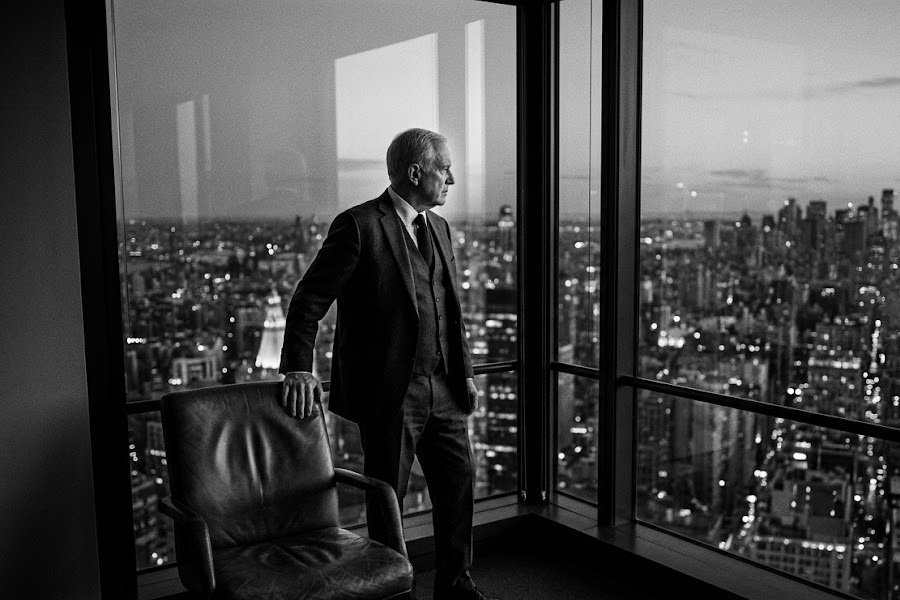
Succession almost never fails in the plan. It fails in the founder who wrote it.
I have sat in enough of these rooms to know the shape of the thing before anyone speaks. The document is excellent. There is a timeline, a governance structure, a shareholders’ agreement redrafted by a firm that charges properly for it, a named successor with a credible CV and the quiet endorsement of two non-executives. Everything that can be written down has been written down. And two years later the founder is still there, with a slightly different title, and everybody has agreed not to mention it.
Boards keep trying to solve this at the planning layer. They add another milestone, another review, another clause. It does not work, because the plan was never the problem. Founder succession is not a logistics exercise with a psychological complication attached. It is a psychological event with a logistics wrapper. Until someone is willing to say that out loud, the wrapper will keep getting thicker while nothing underneath it moves.
One clarification before I go further: the founder in these pages is a composite, and I write him as he. The pattern is not male-only.
What the founder is actually protecting
The official story is always the company. He is staying for continuity. He is staying because the market is turbulent and this is not the moment. He is staying because the successor is nearly ready — nearly is the load-bearing word — and it would be irresponsible to hand over a business at this delicate juncture to someone who has not yet been through a downturn.
Every one of those sentences may be factually defensible. None of them is the reason.
The reason is that this founder has spent thirty years being one thing to everyone who knows him. He is the founder. At the tennis club, at his daughter’s wedding, in the regional newspaper, in his own kitchen — he is the man who built it. That identity is not a role he performs. It is the only version of himself that has ever been fully legible to other people, the one that needs no explanation, the one that arrives in the room before he does. Ask him who he is without the company and you will get a joke, a deflection, or a long silence. The silence is the honest answer.
So when we talk about a founder refusing to let go of control, we are describing the surface of it. What he is actually holding is the last place where he is unambiguously somebody. That is a far harder thing to hand over than a signing authority, and it explains why arguments about governance bounce off him. You cannot argue someone out of a position that is holding their identity upright.
The company as the last attachment object
Here is the part that tends to land badly and then, a week later, land properly.
For a great many founders, the company is not primarily an asset. It is a relationship — and specifically, it is the relationship that never left. Partners have come and gone. Children grew up and moved to Amsterdam or Singapore. Friendships thinned out around year twelve, when he was working the way you have to work to make something survive, and never quite thickened again. Parents died. The company stayed. It answered when he called at eleven at night. It needed him in a way that was uncomplicated and constant, and it never once told him he was too much.
I have written before about the isolation that arrives with the top job and how few leaders have anywhere honest to put it. In founders approaching succession, that isolation has usually had decades to set. The business has quietly absorbed the emotional function that a wider life would otherwise carry. It has become an attachment object — the thing that regulates him, that tells him he is needed, that gives the day its shape and the week its meaning.
Now the board would like him to give it away, and to be gracious about it, and to attend the announcement dinner.
This is why the resistance is so much larger than the stated objections can account for, and why it is so resistant to logic. He is not negotiating a transaction. He is being asked to survive a loss, in public, with a smile, on a timetable set by other people.
The four behaviours boards recognise immediately
None of what I have described stays interior. It comes out sideways, in behaviour, and it is remarkably consistent from company to company. When I describe these to a supervisory board, people start looking at the table.
The office that was never given up
He keeps a room. Smaller than before, of course, further down the corridor, purely practical. But it is in the building, and the door is open, and people walk past it. Which means the organisation now has two places to go for an answer, and everybody’s nervous system knows which one is the real one.
The advisory seat that functions as a shadow throne
He steps back to a non-executive or advisory position with no formal authority — and discovers that the informal kind was always the one that mattered. He does not need a vote. He needs only a raised eyebrow in a management meeting, and a decision that took the new chief executive six weeks quietly dies in six seconds. This is the difference between authority and legitimacy made painfully concrete: the successor has the authority, the founder still has the legitimacy, and the organisation follows legitimacy every single time.
The successor built in his own likeness
A founder will often select, consciously or not, a version of himself twenty years younger. It feels like rigour. It is actually reassurance — proof that what he built was not merely personal, that the method is transferable, that he was right. And it sets up the cruellest dynamic in the whole handover, which I will come to.
The date that moves by one good quarter at a time
The exit was set for December. Then the acquisition came up, and it would be strange to leave mid-process. Then the numbers were strong and it seemed unwise to disrupt momentum. Then the numbers softened and it seemed unwise to leave the successor exposed. Each postponement is individually reasonable. Strung together over three years they form a pattern nobody in the room is willing to name, and the naming is the whole job.
The one thing the successor is never given
Follow the fourth behaviour to its conclusion. A successor chosen in the founder’s likeness is set an impossible task: to be the same, but also to be new. He is praised for continuity and quietly resented for imitation. And he is systematically denied the single experience that would make him a real leader in the eyes of the organisation — the right to be wrong in public, and to recover from it without rescue.
I am not writing here about the successor’s own psychology, which deserves its own treatment. I am writing about what the founder does to him, usually while believing the opposite.
Every founder earned his authority by getting things badly wrong in full view and surviving. That is where legitimacy actually comes from. Then he protects his successor from precisely that experience, intervening early, catching the error before it costs anything, calling it mentorship. The successor is kept in a state of permanent apprenticeship, and the organisation reads it exactly right: this one is not yet real.
I would go further. This is one of the clearest expressions of the shadow side of leadership I encounter. The founder genuinely believes he is protecting the business. What he is protecting is his own indispensability, and the proof of it arrives every time he has to step in. The rescue confirms the necessity. The necessity justifies the rescue.
Around all of this, the distortion field that forms around a long-tenured leader does its quiet work. Nobody tells him. The management team learned years ago what happens to unwelcome accuracy. The board is composed of people who admire him, several of whom he appointed. And so the one person in the building who most needs the truth is the last to receive it — which is the hidden narrative running underneath the decision long before anyone gets to the merits.
A grief no one will let him call grief
Now the part that gets left out entirely.
This is not the grief that arrives after the exit. That one at least has a name, a date and a certain permission attached to it. This is the grief that arrives years earlier, while he is still in the chair, still signing, still ostensibly fine — and it is the reason the handover keeps not happening.
We have an entire permitted vocabulary for the company’s side of a founder handover. The company mourns. The company loses a legend. There are speeches, a portrait, a gift, a piece in the trade press about the end of an era. All of it is sanctioned.
The founder gets none of that. He is expected to be delighted. He is congratulated on his freedom, asked what he will do with all that time, told he has earned it. Any hint that he is not delighted is read as ego, as difficulty, as a founder who cannot let go. So he does not say it. He cannot say I am about to lose the thing that has told me who I am every morning for thirty years, and I have no idea what stands up in its place. There is no room in the conversation for that sentence.
And a bereavement that cannot be named does not disappear. It converts into behaviour — into the office, the eyebrow, the moved date. What looks from the outside like a grab for control is, far more often, an unmourned loss looking for somewhere to go.
What actually moves it
Not another milestone. What moves it is someone willing to say the true thing to the founder’s face, early, and stay in the room afterwards.
In practice, that means separating the two conversations that boards insist on merging. There is a governance conversation — mandate, decision rights, what the founder may and may not touch, written with a precision that makes ambiguity impossible. That belongs in the boardroom, with the dynamics named honestly, and it should be brutally specific, because vagueness here is not kindness; it is the mechanism by which the shadow throne is built.
And there is a wholly different conversation, which is not a board conversation at all: who is he when the building no longer needs him, and what will he be for, from Monday. That question deserves a year, not an afternoon. Most founders have never once been asked it. When it is finally asked properly — by someone with no stake in the answer, no shares, no career depending on the outcome — the governance conversation stops being a proxy war, because the founder is no longer defending his existence with a clause.
I am not sentimental about this. Some founders will not do the work, and the board’s obligation then is to the company. But I am unwilling to treat as a character flaw what is plainly a human problem, and one that almost nobody can think their way through alone.
A founder who has grieved the company can leave it. A founder who has not will keep coming back for it, one good quarter at a time, and call it duty.